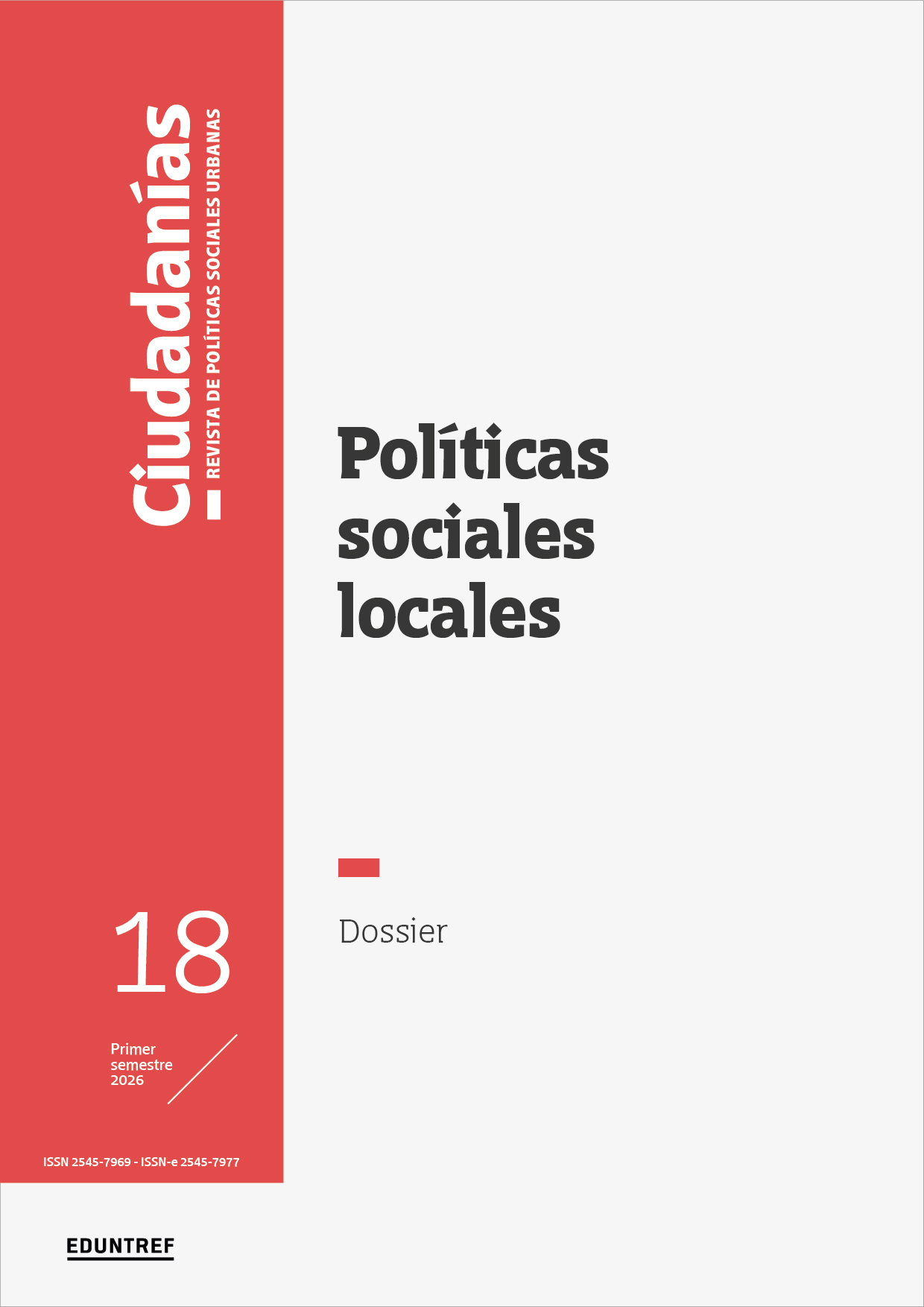
Ciudadanías. Revista de Políticas Sociales Urbanas

Although many social policies are designed at the central levels of the state and framed within broader debates on development, well-being, and redistribution, they truly come into being at the local level, where they acquire their real substance. It is there that public policies intersect with people's concrete living conditions, where rights become effective—or not—where inequalities express their full intensity, and where state responses are put to the test. Thinking about social policies from a local perspective, therefore, means recognizing that the production of well-being is always a situated process, shaped by institutional capacities, social relations, community dynamics, and interrelationships between different levels of government.
The current situation in Argentina makes this perspective particularly relevant. At Ciudadanías magazine, we believe it is timely to dedicate this issue to the management of local social policies, with the aim of contributing to a debate whose academic and political relevance is now undeniable. The profound reconfiguration of state intervention, initiated by the La Libertad Avanza administration and manifested in the dismantling of social protection agencies, programs, and instruments, not only alters the national government's methods of action but also increasingly displaces the effects of these transformations to local communities.
In this context, municipal governments, with their unique understanding of local realities, occupy a strategic position. It is at this level that the tensions between growing needs, scarce resources, and limited institutional capacities are played out. Often exceeding their formal authority and with insufficient resources, municipalities coordinate responses with social organizations, community institutions, and other levels of government to address issues related to food, care, health, housing, disability, violence, childhood, and social integration.
The centrality of the local level is not a new phenomenon. Since the decentralization processes initiated in the late 1980s, municipalities have steadily expanded their social responsibilities. However, this expansion has not always been accompanied by an equivalent distribution of resources, institutional capacities, or management tools. The heterogeneity among local governments—in terms of funding, professionalization, infrastructure, technical capacities, and governance models—constitutes one of the main challenges to guaranteeing equal access to rights in a country marked by profound territorial inequalities.
This dossier, coordinated by Adriana Rofman (FLACSO Argentina) and Carolina Foglia (Instituto del Conurbano - UNGS and FLACSO Argentina), is situated at the intersection of these problems and transformations in social policy. It brings together contributions from researchers whose analyses allow us to understand how social policies are produced, implemented, contested, and transformed at the territorial level, based on complex dynamics of intergovernmental coordination, intersectoral collaboration, and the participation of community actors.
In a context where discussions about the role of the State tend to focus on the profound transformations taking place at the national level, this dossier proposes a shift in perspective. This is not to disregard the central importance and consequences of macroeconomic decisions, but rather to remind us that all social policy ultimately finds its expression at the local level. Understanding this territorial dimension is essential, not only for analyzing ongoing transformations, but also for considering the future challenges of social protection, federalism, and democracy.
From the journal, we would like to express our gratitude for the work and dedication of the dossier coordinators in compiling this issue, to all those who contributed their work, to those who submitted articles to the open submissions section, and to the reviewers of those submissions.
Patricia Davolos
Editor



NUESTROS POSGRADOS:
Maestría y Especialización en Políticas Sociales Urbanas
Especialización en Gestión de Políticas para la Infancia y Adolescencia
CENTRO DE ESTUDIOS E INVESTIGACIÓN EN POLÍTICAS SOCIALES URBANAS:

1.png)